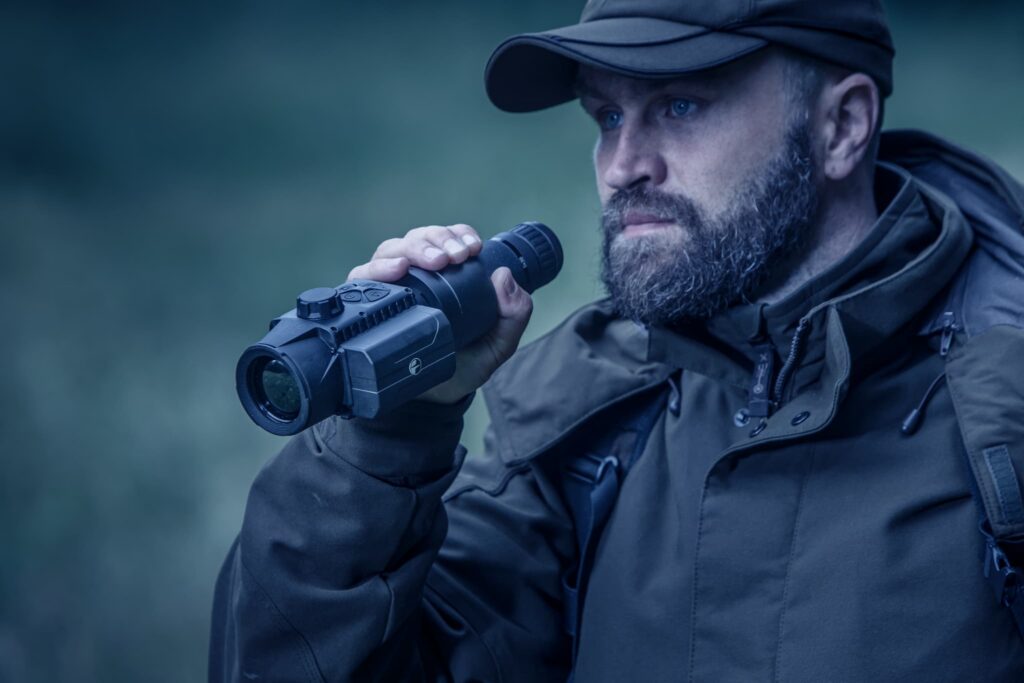
When buying a thermal camera, almost every hunter faces the same question.
Choose a cheaper model or invest in a quality device straight away?
At first glance the answer seems simple.
If two devices look similar and both promise to show an animal more than a kilometre away, why pay more?
In practice the differences only start to show in the forest.
And often it turns out months or years later that the cheap purchase was actually the most expensive solution.
Cheap and good value are not the same thing
First, two things need to be distinguished.
A good-value purchase means a good product at a reasonable price.
A cheap purchase often means compromises that go unnoticed at the time of buying.
The hunter sees in the advertisement:
- 640×480 sensor
- 1500 metre detection range
- colour AMOLED display
video recording.
Everything seems great.
But a spec table does not always show how the device actually performs in a rainy forest, on a cold winter evening or after several years of use.
The first problem – image quality in real life
Many cheaper devices show an impressive image in the shop or in an online video.
In reality, conditions change constantly.
The Estonian hunter regularly encounters:
- rain
- fog
- wet forest
- thaw
cold winters.
It is in exactly these situations that quality sensors start to show their advantages.
On paper, two thermal cameras can look alike.
In the forest, one may show the animal in detail while the other shows just a warm patch.
When the animal moves fast or is further away, this difference becomes very important.
The second problem – battery life
Nothing is more unpleasant on a hunt than the device switching off at the crucial moment.
With cheaper devices, savings are often made on:
- battery quality
- optimisation of power consumption
reliability of the electronics.
The result can be:
- shorter operating time
- rapid battery ageing
unstable operation in the cold.
Experienced hunters know that a reliable battery is not a convenience. It is a necessity.
The third problem – software
When talking about thermal cameras, people often think only of the sensor.
In fact, a large part of the work is done by the software.
Good software helps to:
- improve contrast
- bring out detail
- reduce noise
keep the image stable.
A device from a quality manufacturer usually receives regular software updates.
This means the device can become even better than it was at the time of purchase.
With cheaper models there may be practically no software support.
The fourth problem – durability
A thermal camera does not live in a display case.
It goes with you:
- in rain
- in a snowy forest
- in an off-road vehicle
- in a hunting tower
in a backpack.
Over the years the device experiences vibration, humidity, cold and heat.
Devices with a quality body, seals and electronics withstand this.
With a cheaper device, the problem may only appear once the warranty has expired.
The fifth problem – ease of use
Many hunters do not think about this before buying.
A thermal camera is often used for several hours at a time.
If the menu is complicated or the controls awkward, it quickly becomes annoying.
A good device allows:
- fast start-up
- a logical menu
- easy operation with gloves
quick access to the main functions.
These small details affect the user experience every day.
The sixth problem – resale value
This is an aspect beginners often do not consider.
What happens when you want to move to a newer model in three or four years?
Devices from well-known manufacturers usually hold their value much better.
If you decide to sell the device, buyers are easier to find.
An unknown or little-known brand can lose a large part of its value very quickly.
What do experienced hunters buy?
If you look at hunters who have used thermal cameras for years, you notice one interesting thing.
Most of them no longer talk about price.
They talk about:
- image quality
- reliability
- battery life
- comfort
confidence.
The reason is simple.
If you spend dozens or hundreds of hours in nature every year, the quality of the device becomes far more important than the initial price difference.
Is a cheap thermal camera always bad?
No.
Not all affordable devices are bad.
For many hunters even a simpler model can be perfectly adequate.
It is important to understand that buying a thermal camera is not just about comparing specifications.
It is an investment in a tool you expect to use for years.
How to make a smart choice?
Ask yourself three questions.
- How often will I use the device?
- In what conditions do I hunt?
- Do I want to buy once, or start looking for a new device in a few years?
If you use a thermal camera rarely, a simpler solution may be sensible.
But if hunting is a regular hobby or an important part of your life, it is worth thinking long term.
Summary
A cheap thermal camera may seem like a good saving at the time of purchase.
But when you consider image quality, reliability, battery life, software, ease of use and value retention, the cheap solution may turn out to be the most expensive in the long run.
A good thermal camera is not just a device.
It is a tool you must be able to rely on every hunting day, in every weather and in every situation.
That is why experienced hunters do not usually ask:
- "How much does it cost?"
They ask:
- "Can I rely on it when I need it most?"