Watch the video comparison to see how the images from a thermal camera differ from those of a standard video camera.
The following videos show how and in what ways the image from a thermal camera differs from that of a standard video camera.
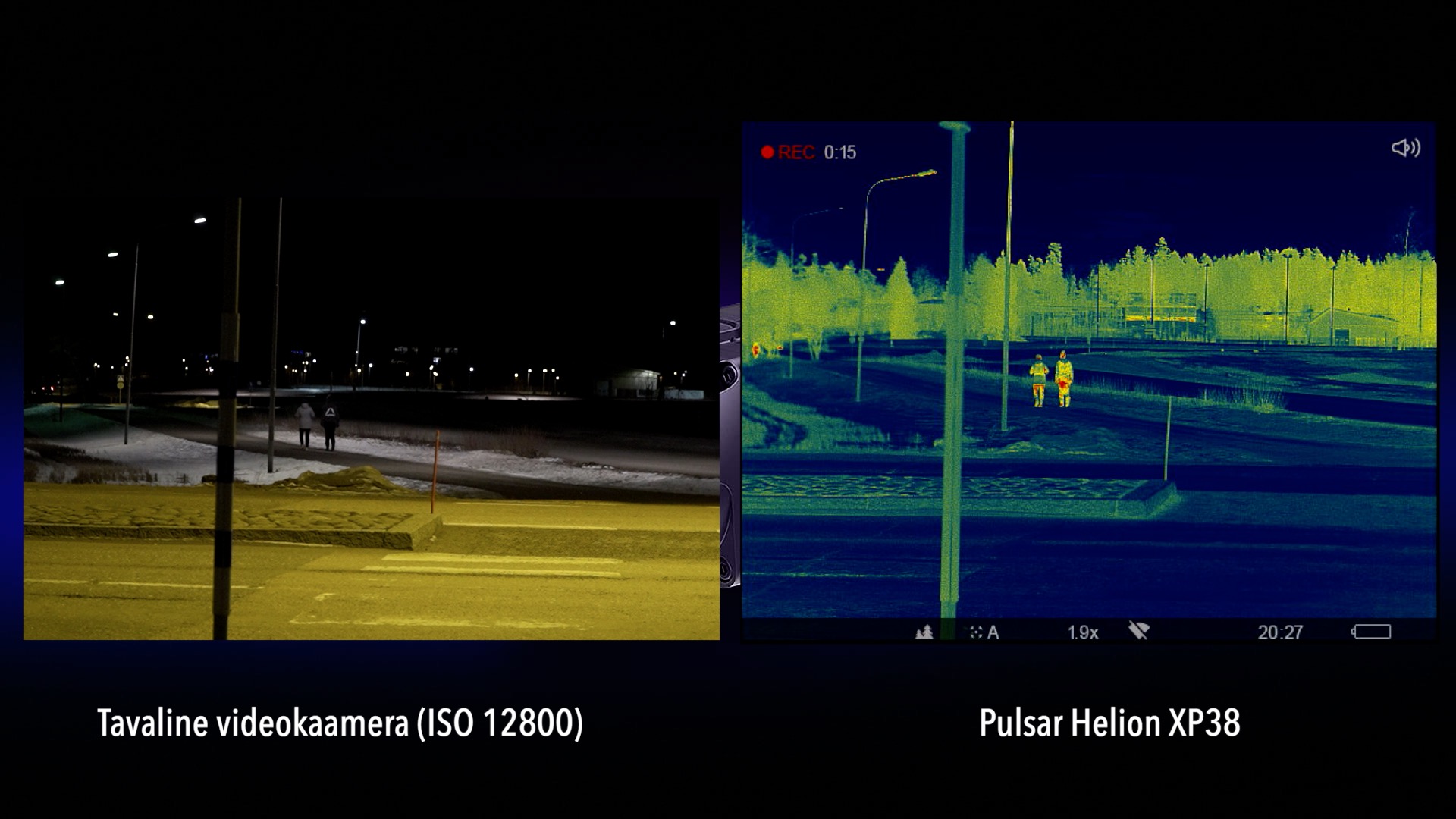
As it is not possible to film in complete darkness with a standard video camera, we carried out the experiment on a dark winter’s evening under street lighting, where some objects nevertheless remained in the shadows of the night. For the test, we used a standard Sony video camera and a Pulsar Helion XP38 thermal imaging camera.
The junction as seen through a thermal camera
The first video shows a junction about 150 metres away, with cars and pedestrians moving about. The forest in the background, which is invisible in the darkness of night, is particularly clear on the thermal camera. The video also clearly shows that, for a thermal camera, it makes no difference what is within the beam of light; only the thermal radiation of objects is visible. Thus, the thermal camera’s image does not show the streetlights’ beam on the pavement; instead, the image is formed based on the thermal radiation of the objects.
People walking outside
The following two videos show people walking along a cycle path; they are only visible on the standard video camera footage thanks to the street lighting. In contrast, the thermal camera footage also captures objects that lie outside the range of the street lights.
Summary
The videos above help to better understand how a thermal camera image differs from a human’s view of the surroundings. For example, in a thermal camera image, the beams of light from street lamps are not visible at all, and it is not the colour of an object that matters, but its temperature.