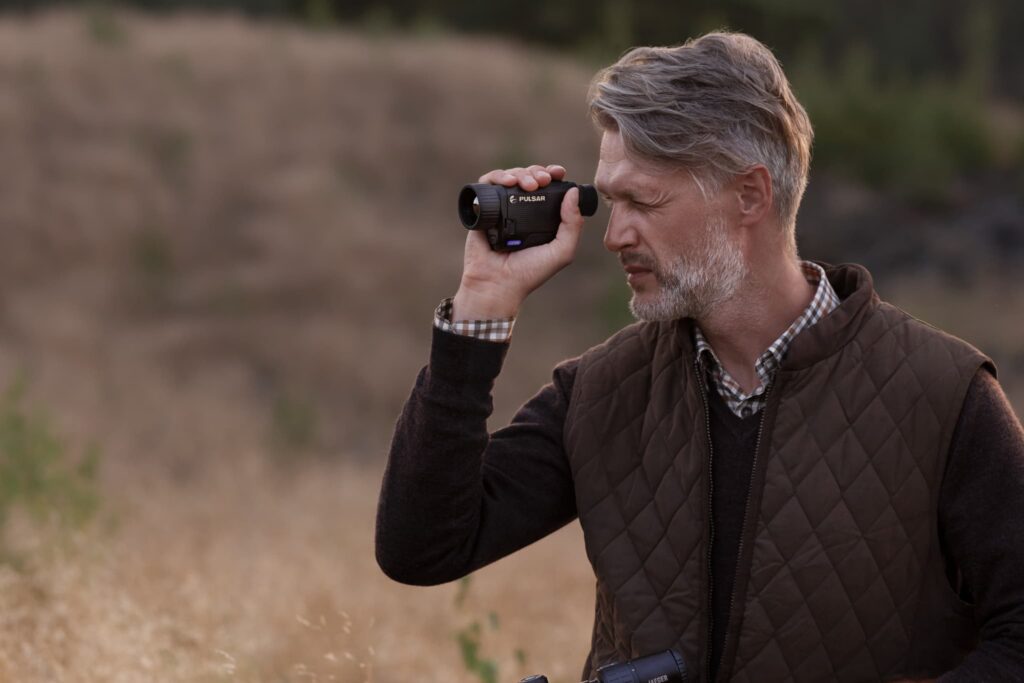
Ask an experienced hunter which piece of equipment has changed hunting the most in recent years and most of them will answer with one word – the thermal camera.
The reason is simple. Animals often move when visibility is poor. Dusk, night, rain, fog or dense forest make it hard to spot game even with good binoculars. A thermal camera lets you see what the naked eye cannot.
But before you buy, it is worth understanding which features really matter and which device suits your hunting style.
What does a thermal camera actually do?
Many beginners mistakenly think that a thermal camera can see through trees or bushes.
In reality, a thermal camera detects the heat radiation of objects. Every animal, person or vehicle radiates heat. The device turns this into a visible thermal image.
In practice this means that a wild boar, moose or wolf can be detected much earlier than with conventional optics.
A good thermal camera helps answer the three most important questions:
- Is there an animal?
- Where is it?
- What is it doing?
These are the questions a hunter needs a quick answer to.
When is a thermal camera most useful?
Evening and night hunting.
Searching for wounded game.
Watching fields and feeding areas.
Tracking predators.
Observing game movement before the hunt.
Wild boar hunting.
Wolf hunting.
Watching beavers.
In practice, many hunters use a thermal camera far more for observation and assessing the situation than for shooting.
Why can a cheap thermal camera disappoint later?
At first glance all devices may look similar.
Advertising often promises a detection range of 1500 or even 2000 metres.
In reality, it is not only important that the device notices an object.
What matters is whether you can tell which animal it is.
For example, a cheap device may show a warm spot at 500 metres.
A quality thermal camera lets you tell at the same distance whether it is a wild boar, a moose or a person.
For the hunter, identification is what matters most.
What does NETD mean and why is it talked about so much?
NETD indicates the sensitivity of a thermal camera.
The lower the number, the more detail you see.
On a dry, cold winter evening almost any thermal camera may perform well.
The difference shows in difficult conditions:
- rain
- fog
- wet forest
- thaw
humid air.
In such conditions a quality sensor shows more detail and the animal stands out better against the background.
That is why experienced hunters prefer devices with a NETD value below 25 mK.
Which lens to choose?
It depends on your hunting ground.
A 35 mm lens is well suited to:
- forest hunting
- mixed terrain
observation on the move.
The field of view is wider and finding the animal is easier.
A 50 mm lens is better suited to:
- large fields
- open terrain
watching over longer distances.
If most of your hunting takes place in the forest, too much magnification is often even a disadvantage.
Why do many Estonian hunters choose Pulsar?
Pulsar has earned a strong reputation for reliability and image quality.
Hunters particularly value:
- the natural thermal image
- fast start-up
- the simple menu
- the durable body
- interchangeable batteries
available warranty and service.
It also matters that Pulsar devices are built to work in Nordic conditions.
Which thermal camera suits a beginner?
If the aim is to get a first quality thermal camera that will serve for years, the Pulsar Axion 2 XG35 is a very good choice.
Its advantages:
- compact size
- low weight
- excellent image quality
- easy to use
suited to both observation and hunting.
Many hunters consider it one of the best all-round thermal cameras.
Which thermal camera suits a demanding user?
If you want maximum detail and detection range, look at the Pulsar Telos series.
The Telos LRF XG50 offers:
- a highly sensitive sensor
- a clear image even in difficult weather
- a built-in rangefinder
- a long operating range
an ergonomic body.
This is a device for the hunter who wants to see more and further.
What should you not skimp on?
Sensor quality.
Thermal sensitivity.
Battery life.
Optical quality.
These features affect the result on every hunting day.
Summary
A thermal camera is not just another electronic gadget. It is a tool that helps you spot game earlier, assess the situation more accurately and make better decisions.
A good thermal camera saves time, increases safety and makes hunting more effective.
If you are looking for a reliable solution for Estonian conditions, choose a device from a well-known manufacturer whose quality has been proven by thousands of hunters across Europe.
The right thermal camera is not an expense. It is an investment that will serve you for years.