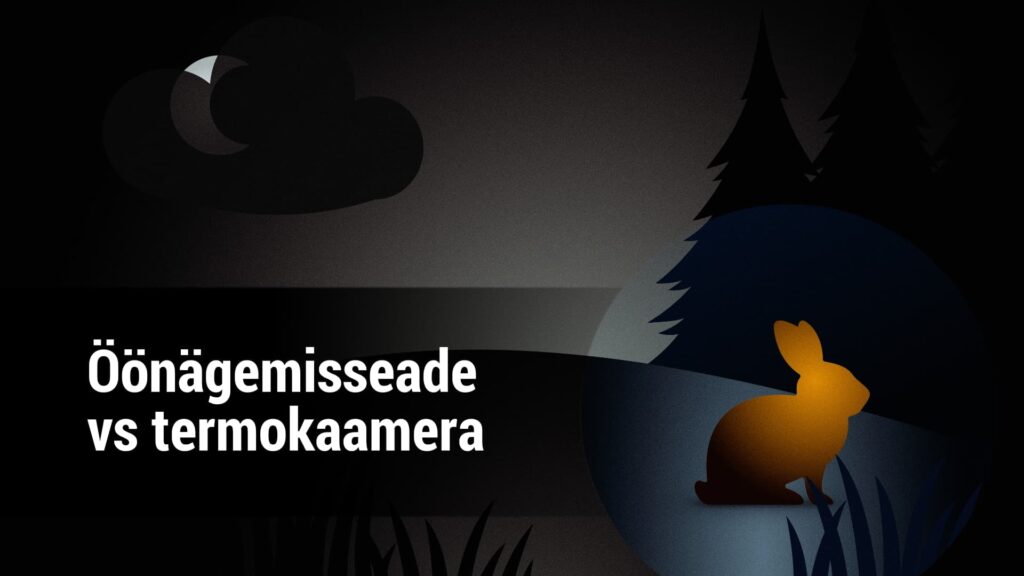
In case you've been wondering which side of the night vision and thermal imaging cameras are different, the mystery is now solved.
This short video will help you easily understand the difference between night vision devices and thermal imaging cameras.
Imagine you want to see what is creeping around in the dark, and you have two tools for it: a night vision device and a thermal imaging camera. Although both help us see in the dark, they work in completely different ways.
A night vision device is like an amplifier
This device captures even the faintest light, such as moonlight or starlight, and makes it thousands of times brighter on the screen. The image you see is usually greenish. It is good for making out details at close range, such as facial features or number plates.
Its drawback, however, is that when it is pitch dark (a cloudy or rainy night), a night vision device will not work without a special additional light source, because there is no light for it to amplify. Some night vision devices do have an infrared illuminator, but its beam range is fairly limited.
A thermal imaging camera is a thermal radiation detector
A thermal imaging camera does not depend on light at all. Instead, the device “sees” heat! All living creatures and machines emit heat. On the thermal imaging camera’s screen, warm objects (such as an animal or a person) glow brightly, while the cold forest in the background is dark (depending on the selected colour palette).
A thermal imaging camera works perfectly both by day and in pitch darkness, as well as in thick fog or even smoke. With it you can find an animal hiding behind bushes in an instant, because its body heat gives it away. On the other hand, it is harder to make out precise details with a thermal imaging camera.
Summary
A night vision device amplifies light and shows what things look like, whereas a thermal imaging camera sees heat, i.e. it shows the temperature of things.