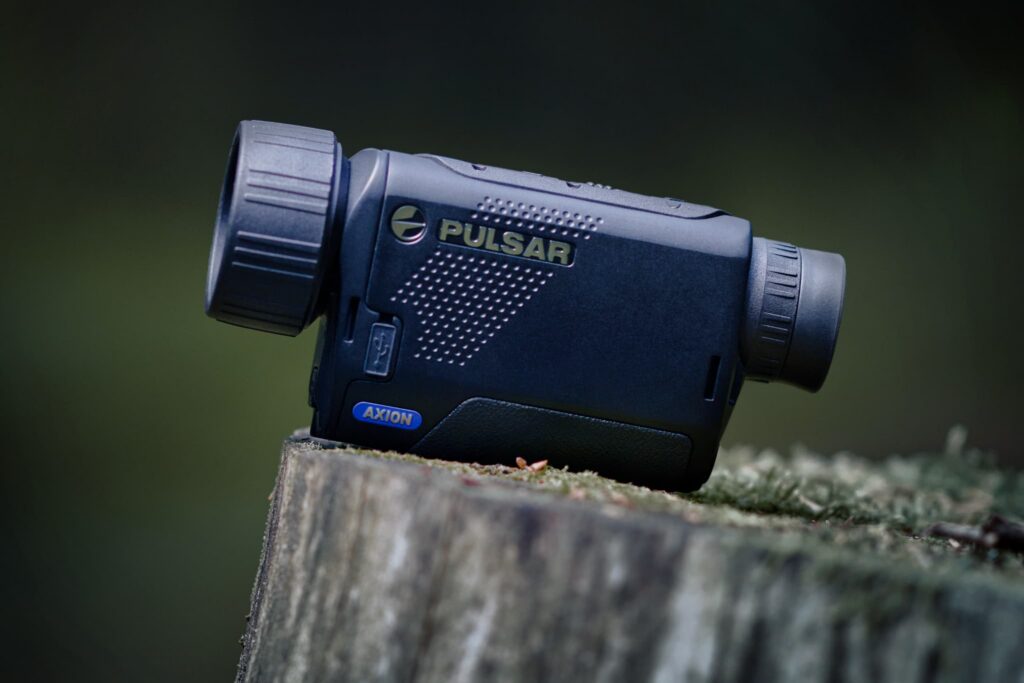
Ask experienced wildlife observers what has changed observation the most in recent years, and most of them will answer simply – thermal camera. At the same time, choosing a thermal imaging camera is not necessarily easy, because top-of-the-range devices are not exactly cheap, and both the device itself and the purchase come with a number of other risks. Before buying, it is worth analysing what the device actually lets me do and which option best suits my own observation needs.
How is a visible image created from thermal radiation?
A thermal imaging camera cannot see through physical obstacles such as masonry, walls, trees and so on. The device detects thermal radiation. Every animal, person or vehicle gives off heat, and the thermal device turns it into a visible image. In practice, this means that a wild boar, an elk or a wolf can be detected in conditions where you would otherwise fail. A good device helps answer three questions: whether something is there, where exactly it is and what it is doing.
Watch the video below to see how a thermal imaging camera works.
When is a thermal imaging camera most useful?
A thermal imaging camera is most useful for evening and night-time wildlife observation or hunting – for example when searching for a wounded animal, watching fields or feeding areas and tracking the movement of animals. A thermal imaging camera is also truly indispensable in scrub, in tall grass and at distances where the human eye can no longer distinguish an animal from its background, while a thermal device copes with this easily.
Hunters, for example, use thermal attachments more for assessing situations and watching animals than for shooting. This makes hunting safer and more informed.
Detection versus recognition
Manufacturers' specifications often mention a detection range of 1500 or even 2000 metres. These figures usually apply under ideal conditions and refer mainly to noticing an object. In practice, it is also important to distinguish detection from identification. At 500 metres a cheaper device may show only a warm dot. A higher-quality device lets you clearly tell at the same distance whether it is a wild boar, an elk or a person.
Three factors that really matter
Image clarity
The more pixels the sensor has (resolution), the more clearly you can see the animal's shape, its movement and even finer details. A cheaper device often shows only a blurry warm patch, while a better one lets you tell what you are looking at from further away.
Sensitivity
A sensor's NETD shows how fine the temperature differences are that the device can distinguish. The lower the number, the better. Recently there has been more and more talk of sNETD too, because image processing affects the final picture at least as much as the sensitivity of the sensor itself. Good image processing keeps the picture clearer precisely when the weather is damp or foggy or the temperature differences are small.
Lens
For example 35mm is well suited to woodland, where you need a wider field of view and a quick sweep of your surroundings. 50mm works better in open terrain, where range matters more. Too much magnification can become awkward in the forest, as the image gets narrow and unsteady.
Where can cutting corners cost you?
It is not wise to cut costs blindly on sensor quality, sensitivity, battery life and optics. They affect the result every time you go out. A cheaper device may seem economical at first, but can prove more expensive in the long run. That does not mean a cheaper device can never be the right one. What matters is defining the tasks you plan to use the device for and identifying the minimum requirements that follow from them.
Which device is right for you?
For a beginner looking for a first proper device that will last for years, a good choice is the compact Pulsar Axion 2 XG35 – light, easy to use and suitable for both observation and hunting. If you want maximum detail and a built-in rangefinder, it makes sense to look at the Pulsar Telos LRF XG50 for example.
In conclusion
A thermal imaging camera is not just a purchase. It is a tool that helps you spot things earlier, assess the situation more accurately and make sounder decisions. The right choice will serve you for years.
If you want a solution suited to Estonian conditions, you can browse our range of thermal imaging cameras or ask Optikwelt directly for advice.
NB! When giving advice, Optikwelt's principle is to help you find a device that matches both your budget and your needs. It matters to us that you are completely happy with your purchase, so please don't hesitate to ask for advice.