
For humans, seeing with two eyes is natural. It gives a stereoscopic image. This is essential for getting around in our surroundings, because movement, distances and terrain are much easier to judge with two eyes. But once optical devices come into play, things are no longer so simple. In some situations a binocular-type device is more convenient, in others a monocular-type one.
Whereas in the past mainly optical observation devices were available, today they have been joined by a variety of digital alternatives, such as thermal imaging cameras and digital binoculars. The options have expanded, but the basic body type has remained the same: either a monocular or binoculars. So the question raised in the title applies to digital devices as well.
Technological challenges
Making observation devices is a challenge in its own right. With binoculars, the two barrels must point at exactly the same spot. If the axes diverge even slightly, the images do not merge and you get a headache. Every additional lens, prism or display adds weight and cost and can make the image dimmer. Magnification amplifies image shake. The further you want to see, the larger the objective lens you need. The manufacturer has to decide whether the device will be light and handy or let you see as far as possible. You cannot have both equally well.
That is why the first observation devices were telescopes (17th century). Binoculars came into use much later, once people had learned to combine two telescopes in a way that was also comfortable to look through. Binoculars only became widely used in the 19th century. Before that, people looked into the distance with a telescope not because it was more natural, but because it was the only way such a device could be made. The same body logic is now repeating itself in thermal imaging cameras and other digital devices.
Binoculars
Binoculars are convenient because they work in harmony with our own vision, which our eyes already know how to use. You look with both eyes and get a stereoscopic image. Movement and distance remain easy to perceive, and there is no need to squeeze one eye shut. A long observation does not strain one eye. At moderate magnification, the field of view is wide enough that the subject does not drop out of view with every slight movement.
The advantage of binoculars lasts as long as their weight remains reasonable for the hand. Increase the size of the objective lens and the device becomes less comfortable: it is tiring to hold, the field of view narrows and the hand starts to shake. At that point binoculars are no longer a convenience but a burden.
Short film
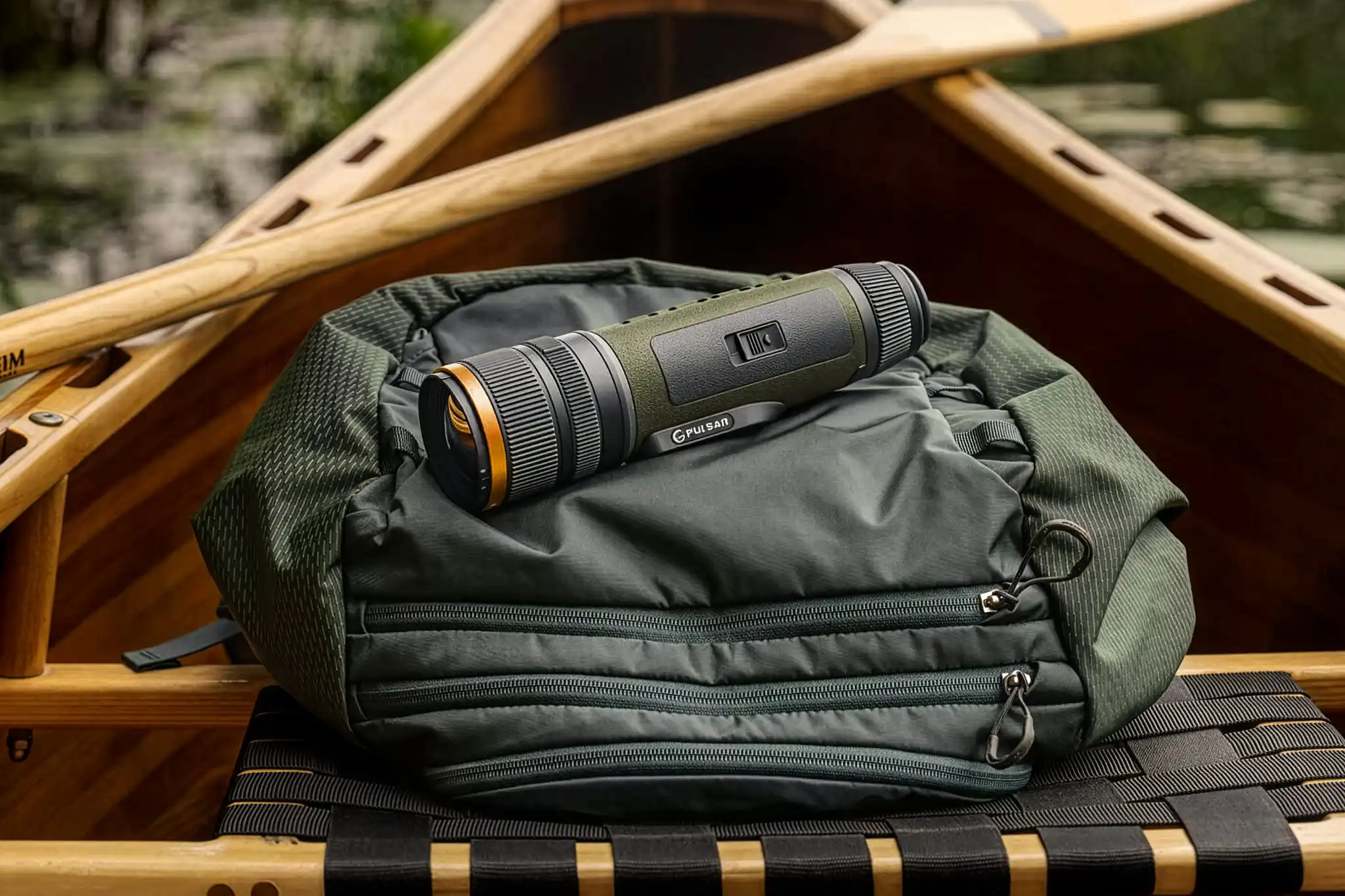
A monocular is more practical and comfortable where binoculars become unwieldy. For the same weight and price you get a larger objective lens and higher magnification than with binoculars. The stereoscopic image is deliberately sacrificed in order to see further or to hold the device in one hand. A monocular with very high magnification already needs a tripod.
Digital devices
With digital devices, the rules of the game change slightly. Classic optical binoculars are two spotting scopes side by side – two objective lenses, two slightly different views, a true stereo image. Many digital binoculars and thermal binoculars have one lens and one sensor. The image is sent to two eyepieces. Both eyes are working, your head does not tire as quickly and you do not have to squeeze one eye shut. You still do not get depth from two viewing angles, though. It is comfortable viewing, not the same effect as with optical binoculars.
Magnification is also considerably limited in digital devices. The sensor cannot keep adding detail indefinitely, and digital zoom soon starts to destroy the image. A digital binocular cannot yet replace the twenty- or sixty-fold view of a daytime optical spotting scope. Rather, it replaces a handheld monocular: easy searching, both eyes open, good detail and additional image enhancement features, e.g. improved visibility at dusk.
What and when?
The list below is a rough guide. It is worth remembering that the exception proves the rule.
- Daytime, fast-moving subject, up to a few hundred metres:
- daytime binoculars with moderate magnification.
- Daytime, long distance:
- a daytime spotting scope (with a tripod if needed).
- Darkness, fog, vegetation, quick target acquisition:
- a monocular-type thermal imaging camera.
- Long night-time observation:
- thermal binoculars.
- Long observation sessions, both day and night:
- day and night binoculars, i.e. thermal and digital binoculars.
Summary
In fact, the question is not whether a monocular is “better” than binoculars. The question is where and what you are observing, and whether the image needs to come from visible light or from thermal radiation.